Thumb 1 Thumb 2 Thumb 3 Thumb 4 Thumb 5

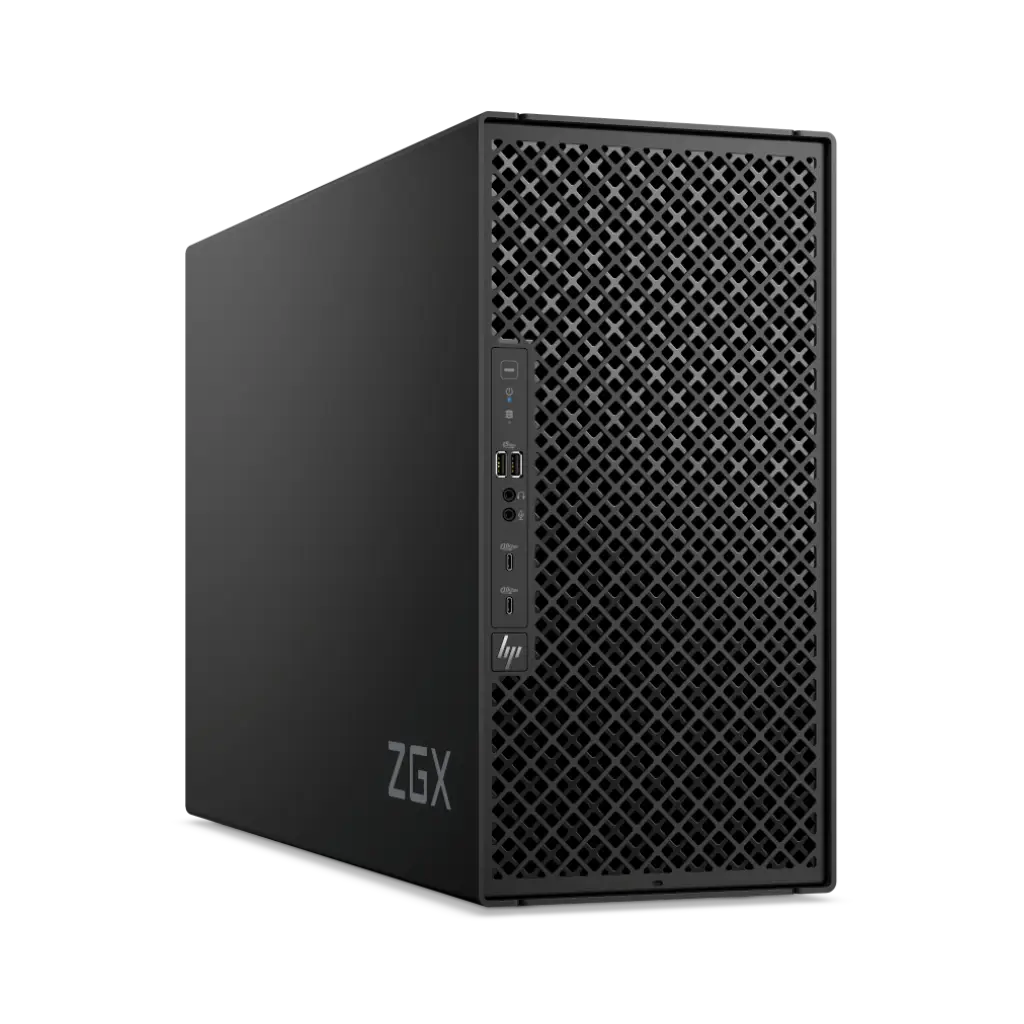
HP ZGX Fury AI station | 20 core Arm CPU | 128 GB LPDDR5x | 4 TB NVMe | NVIDIA DGX OS | 1-year warranty

☆ ☆ ☆ ☆ ☆ 0.0 (0 reviews)
Need Assistance?

Request For Quote

On Backorder Data sheet
  • ✔️ NVIDIA Grace Blackwell
  • ✔️ 20-core Arm CPU (10x Cortex-X925 + 10x Cortex-A725)
  • ✔️ 128 GB LPDDR5x unified system memory
  • ✔️ 4 TB NVMe M.2 SSD, self-encrypting
  • ✔️ Wi-Fi 7, Bluetooth 5.4, 10GbE LAN and USB4 Type-C
  • ✔️ NVIDIA DGX OS
  • ✔️ 1.2 kg Weight
  • ✔️ 1-year limited warranty
See more product details
Enquiry Now

Description

NVIDIA GB300 Grace Blackwell Ultra SuperchipNVIDIA GB300 Grace Blackwell Ultra Superchip in HP ZGX Fury AI station delivers powerful on-premises AI computing, offering up to 20 petaFLOPS of FP4 performance and 748 GB of unified memory.

Ready to Run with Ubuntu 24.04 LTSThe HP ZGX Fury G1n comes preinstalled with Ubuntu 24.04 LTS and NVIDIA AI Developer Tools, including drivers, CUDA, and container tools. Start developing, training, and deploying AI models with a ready-to-use software environment.

Coherent Memory and Discrete GraphicsDevelop and fine-tune AI models with up to 100 billion parameters or run inference on models with up to one trillion parameters using 748 GB of coherent unified memory. Offload graphics workloads to an optional NVIDIA RTX PRO GPU for additional flexibility.

Fast and Secure StorageChoose between 2 TB and 4 TB NVMe M.2 self-encrypting storage options. These configurations support large AI datasets, model files, and development workloads while providing storage-level encryption capabilities.

HP ZGX AI Stations SoftwareHP Z Toolkit and HP Z Runtime help streamline AI workflow setup and deployment. Connect remotely to a Z workstation from another device and use simple commands to pull and serve AI models across compatible ZGX systems.

Specification

Architecture NVIDIA Grace Blackwell
GPU NVIDIA Grace Blackwell GB10 Superchip, up to 1 PetaFLOP AI (FP4), 6144 CUDA/Tensor/RT cores
CPU 20-core Arm (10x Cortex-X925 + 10x Cortex-A725)
CUDA Cores 6,144 CUDA Cores
Tensor Cores 5th Generation
RT Cores 4th Generation
Tensor Performance 1 PFLOPS
System Memory 128GB LPDDR5x Unified Memory
Memory Interface 256-bit
Memory Bandwidth 273 GB/s
Storage 4 TB NVME.M2 with self-encryption
USB 4x USB TypeC
Ethernet 1x RJ-45 connector 10 GbE
NIC ConnectX-7 Smart NIC
Wi-Fi WiFi 7
Bluetooth BT 5.4
Audio-output HDMI Multi-channel Audio Output
Display Connectors 1 × HDMI 2.1a
NVENC | NVDEC 1x | 1x
OS NVIDIA DGX™ OS
System Dimensions 150 mm L x 150 mm W x 50.5 mm H
System Weight 1.2 kg
Warranty 1-year warranty

FAQ

The HP ZGX Fury AI Station is an AI computing system designed for demanding AI development, machine learning, and data-intensive workloads. It helps developers and businesses run AI applications and accelerate their AI workflows.

The HP ZGX Fury AI Station can support AI model development, machine learning, data science, generative AI experimentation, and other compute-intensive workloads, depending on its configuration.

AI developers, data scientists, researchers, and enterprises working with advanced AI workloads can consider the HP ZGX Fury AI Station based on their performance and infrastructure requirements.

Local AI model execution depends on the system's hardware configuration, available memory, and software compatibility. Check the specific model's requirements before deployment.

Consider your AI model sizes, memory requirements, GPU performance needs, storage capacity, software compatibility, and expected workload before selecting a configuration.

Evaluate its processing performance, GPU capabilities, memory capacity, storage, software compatibility, and scalability to determine whether it meets your AI development and deployment requirements.

It may be suitable for generative AI development depending on its hardware configuration and software support. Check the system's specifications against the memory and compute requirements of your intended models.

Support for large language models depends on available memory, compute resources, model size, and quantization. Review these requirements before choosing a configuration for local LLM development or inference.

An AI workstation is designed to handle demanding workloads such as model training, inference, data processing, and parallel computing. A regular desktop is generally intended for everyday productivity and general-purpose applications.

It may suit enterprise AI projects involving development, experimentation, and inference, depending on workload requirements, software support, security policies, and the system's specifications.

Reviews

There are no reviews yet.